Winter Tires vs All-Season Tires
Compare winter tires vs all-season tires across snow traction, ice grip, cold dry pavement, wet roads, 3PMSF ratings, AWD dynamics, and seasonal use.
Content is based on cited tire-industry standards, manufacturer documentation, and technical references where relevant.
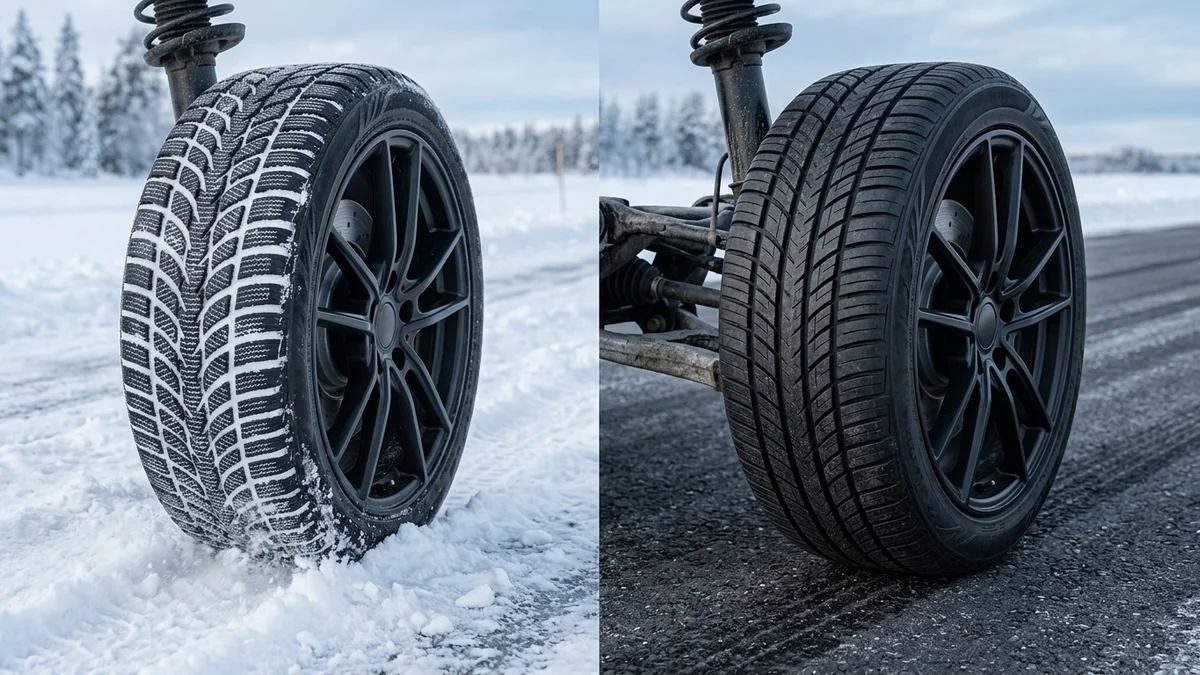
Winter tires are generally the better choice when you regularly drive in snow, ice, or sustained cold because their tread compounds and patterns are designed for winter traction. All-season tires are more convenient for year-round use in moderate climates, but their winter capability varies significantly by model.
Quick Comparison: Winter Tires vs. All-Season Tires
This overview highlights how dedicated winter tires and standard all-season tires compare across key performance dimensions:
| Feature / Condition | Dedicated Winter Tires | All-Season Tires |
|---|---|---|
| Cold-Weather Compound | Remains flexible at sub-freezing temperatures | Broader year-round compromise; hardens in deep cold |
| Snow Traction | Generally stronger deep and packed snow grip | Moderate light snow grip; model-dependent |
| Ice Grip | Generally stronger ice traction; model-dependent | Usually more limited on ice; model-dependent |
| Cold Dry Roads | Maintains rubber compliance and road contact | Good stability, but reduced compound compliance |
| Wet & Slush Evacuation | Winter-focused tread features for snow, water, and slush evacuation | Year-round wet-road drainage with winter capability varying by model |
| Warm-Weather Handling | Softer feel, squirm, and reduced responsiveness | Stable, responsive handling in spring/summer |
| Warm-Weather Treadwear | Can wear faster in sustained warm-weather use | Designed for broader year-round temperature use |
| Seasonal Changeover | Requires semi-annual wheel/tire changeovers | Convenient year-round single set |
| 3PMSF Severe Snow Rating | Common on modern dedicated winter tires | Available on some models; common among all-weather tires |
| Best Use Case | Sub-freezing winters, snow, ice, mountain passes | Mild four-season climates with light winter weather |
Understanding Tire Design: Compounds & Tread Patterns
The fundamental difference between winter tires and all-season tires lies in polymer chemistry and mechanical tread geometry:
What Are Dedicated Winter Tires?
Winter tires are engineered with low-temperature compounds and tread designs intended for cold, snow, and ice. Many use dense siping, numerous biting edges, and more open tread features to maintain traction and evacuate snow or slush.
What Are All-Season Tires?
All-season tires are engineered as a broad compromise designed to provide acceptable performance across wet roads, dry summer highways, and mild winter conditions. Their rubber compounds balance tread longevity, fuel economy, and warm-weather stiffness, sacrificing extreme sub-freezing grip for year-round versatility.
Performance Breakdown Across Winter Driving Conditions
How a tire behaves in winter depends heavily on the specific road surface condition:
In fresh or packed snow, dedicated winter tires generally benefit from low-temperature compounds, dense siping, biting edges, and tread patterns designed to maintain traction in snow. Actual performance varies by tire model and snow condition.
Ice provides very little available friction. Dedicated winter tires generally use compounds and fine tread features designed to improve grip at low temperatures, but ice performance varies substantially by tire model and test condition.
On cold, dry pavement, compound behavior changes with temperature. Dedicated winter tires are formulated for low-temperature operation, while all-season tires balance performance across a broader temperature range. Exact dry-road performance still varies by tire model.
Slush is denser than water and resists rapid evacuation. Dedicated winter tires generally feature tread designs aimed at channeling dense slush and water away from the contact patch, while all-season tires focus on broad year-round wet drainage.
The 45°F (7°C) Rule: Practical Guideline vs. Physical Reality
A widely cited industry rule of thumb states that drivers should switch between seasonal tires when temperatures cross 45°F (7°C). It is important to understand what this rule represents:
Around 45°F / 7°C is a common seasonal-changeover guideline used by tire manufacturers, not a universal temperature at which every all-season tire suddenly loses grip. Actual performance depends on the tire model, road surface, weather, and operating conditions.
Winter Tread Features vs. All-Season Tread Features
What Does the 3PMSF Symbol Mean?
The Three-Peak Mountain Snowflake (3PMSF) symbol branded onto a tire’s sidewall indicates that the tire has met a defined severe-snow traction performance requirement under standardized industry testing (ASTM F1805).
- Specific Test Scope: The 3PMSF rating evaluates straight-line acceleration traction on medium-packed snow relative to a standardized reference test tire.
- What 3PMSF Does Not Independently Test: The 3PMSF standard does not evaluate ice braking distance, ice cornering grip, or snow braking performance.
- Not Exclusive to Dedicated Winter Tires: Modern dedicated winter tires commonly carry 3PMSF, and many all-weather, all-season, and all-terrain products also carry the symbol.
M+S vs. 3PMSF Markings: What Is the Difference?
Many drivers confuse the common "M+S" marking with true severe-snow qualification:
- M+S (Mud and Snow): A geometric standard defined by the Rubber Manufacturers Association (now USTMA). It requires only that the tire tread pattern have at least a 25% open void ratio and lateral grooves oriented toward the tread shoulders. It involves zero performance traction testing on snow or ice.
- 3PMSF (Severe Snow): A performance-based qualification requiring the tire to achieve at least 110% of the snow traction index of the reference test tire in standardized acceleration testing.
All-weather tires are year-round tires that carry the 3PMSF marking and are designed to provide stronger snow capability than ordinary all-season tires. Overall winter performance still varies by model, and dedicated winter tires generally provide the strongest capability in demanding snow and ice conditions.
Winter-Use Categories & The 3PMSF Symbol
Do You Still Need Winter Tires With AWD or 4WD?
A common misconception among drivers is that having an all-wheel drive (AWD) or four-wheel drive (4WD) vehicle eliminates the need for winter tires. Understanding the physics of vehicle dynamics explains why tires remain paramount:
AWD and 4WD can improve propulsion by distributing drive torque across more wheels, but they do not increase the tire-road friction available for braking or cornering. Those limits still depend primarily on the tires, road surface, and operating conditions.
AWD does not replace winter-capable tires.
Why Four Matching Winter Tires Are Recommended
Tire manufacturers and independent tire-testing organizations recommend installing winter tires as a matched set of four to preserve balanced traction and handling:
Mixing winter tires on one axle with materially lower-traction tires on the other can create a front-to-rear traction imbalance and change the vehicle’s handling response during braking or cornering maneuvers.
Winter performance also depends on tread depth and tire condition. As tires wear, their ability to manage snow and slush can decline, so a tire’s category or 3PMSF marking should not be treated as a guarantee of unchanged winter performance throughout its service life.
Decision Matrix: Which Tire Should You Choose?
Use this practical evaluation checklist to determine the ideal tire strategy for your winter driving environment:
Choose Dedicated Winter Tires If:
- ✓You regularly encounter snow, slush, or icy road surfaces during winter months.
- ✓Ambient daily temperatures remain consistently low for several consecutive months.
- ✓You drive early mornings before municipal snow plows and salt spreaders clear roads.
- ✓You navigate steep grades, hilly terrain, unpaved rural roads, or mountain passes subject to seasonal traction laws (where you may also need to find tire chains by tire size or check tire chain requirements by state).
- ✓Maximum winter traction margin is prioritized over seasonal changeover convenience.
All-Season Tires May Be Sufficient If:
- ✓Winter weather in your region is mild, with infrequent snowfall that melts quickly.
- ✓You have the flexibility to avoid driving during severe snow or ice storms.
- ✓Roads in your area are rapidly salted and cleared by municipal road crews.
- ✓You prefer the cost and storage convenience of maintaining a single year-round tire set.
- ✓The specific tire model provides adequate verified wet and light-snow capability.
Cost, Seasonal Changeovers & Tire Storage
While purchasing a second set of dedicated winter tires involves an initial upfront expense, the ongoing wear economics balance out over time:
Splitting annual mileage between two tire sets can reduce the rate of tread accumulation on each set. Tire age and physical condition still matter independently of mileage.
Many drivers purchase an inexpensive second set of steel or dedicated alloy wheels for their winter tires to simplify seasonal garage changeovers and protect primary wheels from winter road salt and chemical de-icers.
Related Tire & Wheel Tools
Explore our interactive sizing calculators to verify tire dimensions, calculate wheel clearances, or check load capacities:
Frequently Asked Questions
References & Authoritative Standards
- Tire Rack Tech Center – What Is the Three-Peak Mountain Snowflake (3PMSF) Symbol?. Technical guidelines explaining severe snow performance standards and testing methodology under ASTM F1805.
- U.S. Tire Manufacturers Association (USTMA). Industry consensus standards on passenger tire markings, M+S geometric definitions, and severe snow certification criteria.
- Consumer Reports – Winter/Snow vs. All-Season Tires. Empirical comparative braking distance, snow traction, and ice grip test data.
- National Highway Traffic Safety Administration (NHTSA) – Tire Safety & Severe Weather Ratings. Federal safety guidelines and testing protocols for passenger vehicle pneumatic tires.
- Michelin North America – When to Switch to Winter Tires. Manufacturer technical guidance on low-temperature compound flexibility and seasonal changeover timing.