Tire Revolutions Per Mile Calculator
Our tire revolutions per mile calculator determines the theoretical number of rotations your tire makes per statute mile and kilometer based on standardized tire dimensions.
Tire Size or Diameter
Parsed: 24.97 in (225/45R17) (Nominal Diameter: 24.97″ / 634.3 mm)
Supports standard metric (e.g. 225/45R17), P-metric, LT-metric, flotation (e.g. 35x12.50R17), and raw decimal diameter (e.g. 33 in).
Calculated Nominal Revs/Mile
Calculated Nominal Revs/KM
Supporting Geometric Dimensions (24.97 in (225/45R17))
Technical notice: Based on nominal tire geometry. Manufacturer-published rolling revs/mile may differ because real tire rolling behavior depends on tire construction, load, inflation, tread condition, and operating conditions.
Calculations use documented geometric and mathematical relationships, with tire-industry standards and manufacturer specifications referenced where relevant.
How to Calculate Tire Revolutions Per Mile
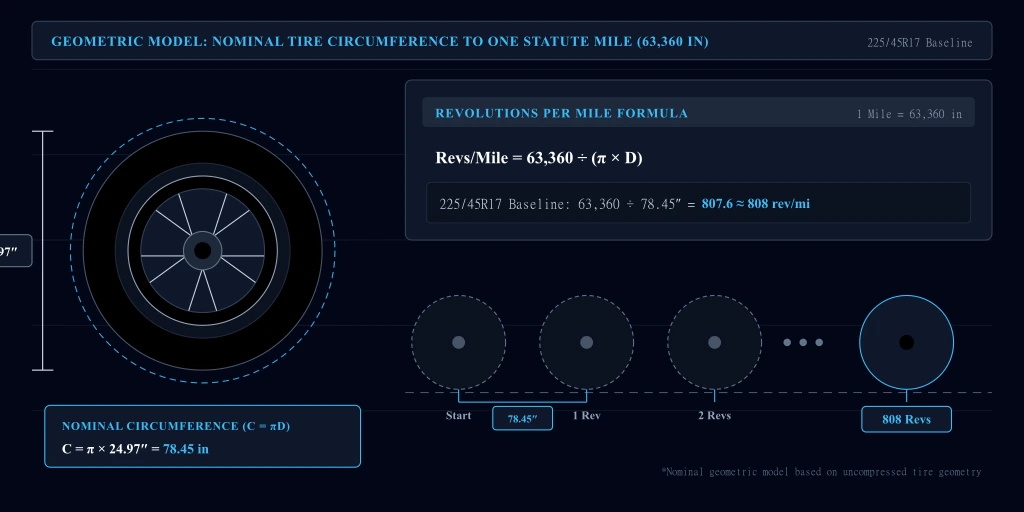
Calculating tire revolutions per mile involves dividing the total number of linear inches in a statute mile (63,360 inches) by the nominal outer circumference of the tire:
Circumference (inches) = π × Diameter (inches)Nominal Revs/Mile = 63,360 ÷ (π × Diameter)Nominal Revs/KM = 1,000,000 ÷ (π × Diameter in mm)In the nominal geometric model, one revolution corresponds to the tire's calculated circumference. Dividing one mile by that circumference gives the calculated nominal revolutions per mile.
225/45R17 Revs Per Mile Worked Example
To see how the math works in practice, consider a standard passenger tire sized 225/45R17. Using standardized tire notation, we calculate the nominal dimensions:
- • Sidewall Height: 225 mm × 0.45 = 101.25 mm (3.99 in)
- • Wheel Rim: 17 inches × 25.4 = 431.8 mm (17.00 in)
- • Nominal Diameter: 431.8 + 2(101.25) = 24.97 inches (634.3 mm)
- • Nominal Circumference: π × 24.9724″ = 78.45 inches (1,993 mm)
- • Calculated Nominal Revs/Mile: 63,360 ÷ 78.4533″ = 808 rev/mi
- • Calculated Nominal Revs/KM: 1,000,000 ÷ 1,992.7 mm = 502 rev/km
Comparison Across Popular Tire Sizes
| Tire Size | Nominal Diameter | Circumference | Revs / Mile | Revs / KM |
|---|---|---|---|---|
| 225/45R17 | 24.97 in | 78.45 in | 808 | 502 |
| 285/70R17 | 32.71 in | 102.76 in | 617 | 383 |
| 35x12.50R17 | 35.00 in | 109.96 in | 576 | 358 |
You can explore complete sizing matrices across all rim diameters on our Tire Diameter Chart.
Nominal Tire Circumference and Revolutions Over Distance
Nominal vs. Manufacturer-Published Revs Per Mile
Nominal tire circumference is calculated from theoretical tire geometry. A real pneumatic tire does not behave like a perfectly rigid circle: it deflects under load and continuously changes shape through the contact patch. As a result, actual rolling circumference and manufacturer-published revolutions per mile can differ from the nominal geometric calculation.
Theoretical Nominal Geometry
Assumes an uncompressed, circular tire crown calculated directly from standard section width, aspect ratio, and rim diameter (63,360 ÷ πD). Ideal for baseline sizing comparisons.
Manufacturer-Published Rolling Data
Some manufacturers publish tire-specific revolutions-per-mile values based on measured rolling data or established internal test/calculation methods. Those published values can differ from the nominal geometric result.
For precision calibration, manufacturer-specific drivetrain programming, or vehicle applications sensitive to rolling-circumference differences, consult manufacturer-published tire data when available rather than assuming the nominal geometric calculation is identical.
Why Larger Tires Have Fewer Revolutions Per Mile
The fundamental principle of rotational kinematics is straightforward: larger diameter → larger circumference → fewer rotations over the same distance.
With unchanged axle gearing and the same transmission gear, the larger tire reduces engine RPM at a given road speed because fewer wheel and axle revolutions are required per mile.
To calculate the mechanical gearing effect and differential ratio required to restore factory torque multiplication after upsizing tires, use our dedicated Tire Size Gear Ratio Calculator.
Where Tire Revs Per Mile Data Is Used
Revolutions per mile data can be relevant across several automotive calibration and drivetrain planning tasks:
PCM & Speedometer Calibration
Some vehicle calibration systems and aftermarket tuning tools use tire size, circumference, or revolutions-per-mile data when correcting speedometer, odometer, or related vehicle calculations after a tire-size change.
Drivetrain & Axle Planning
Revs/mile can also support drivetrain calculations, theoretical road-speed analysis, tire specification comparisons, and axle-ratio planning.
AWD & 4WD Notice: Some AWD and 4WD vehicles have manufacturer-specific requirements for matching tire rolling circumference or tread depth. Consult the vehicle manufacturer before mixing tires with meaningfully different rolling characteristics.
Frequently Asked Questions
How do you calculate tire revolutions per mile?
To calculate nominal tire revolutions per mile, divide the number of inches in one statute mile (63,360) by the nominal tire circumference in inches (π × diameter). For example, a 225/45R17 tire with a 24.97-inch diameter has a 78.45-inch circumference: 63,360 ÷ 78.45 ≈ 808 revolutions per mile.
Why do larger tires have fewer revolutions per mile?
In the nominal geometric model, a tire with a larger diameter has a greater circumference, so fewer rotations are required to cover the same distance.
What is the difference between calculated nominal revs/mile and manufacturer revs/mile?
Some manufacturers publish tire-specific revolutions-per-mile values using measured rolling data or established internal test/calculation methods. Those published values may differ from the nominal geometric calculation.
How many revolutions per mile does a 225/45R17 tire make?
A standard 225/45R17 tire has a nominal diameter of approximately 24.97 inches (634.3 mm) and a nominal circumference of 78.45 inches. It makes approximately 808 calculated nominal revolutions per mile (502 revolutions per kilometer).
How can tire revolutions per mile affect speedometer and odometer calibration?
Vehicle speed and distance calculations often use wheel-speed, driveline, or other sensor data interpreted against the programmed tire or rolling-distance calibration. Installing a larger tire can cause indicated speed and distance to differ from actual values if the vehicle is not recalibrated. To compare speedometer deltas directly, use our Tire Size Calculator.
Are tire revs per mile the same as wheel RPM?
No. Revolutions per mile (revs/mile) is a fixed distance rate (rotations per 5,280 feet), whereas wheel revolutions per minute (RPM) is a rotational speed that varies continuously depending on vehicle velocity (Wheel RPM = MPH × Revs/Mile ÷ 60).
Authoritative Standards & Technical References
- Tire and Rim Association (TRA): Tire dimensional conventions and design data.
- European Tyre and Rim Technical Organisation (ETRTO): Tire design dimensions and theoretical rolling-circumference conventions.
- Tire Rack — Tire Tech: Calculating Dimensions & Revolutions Per Mile: Secondary technical reference explaining nominal tire geometry and manufacturer-published rolling data.