Tire Size Gear Ratio Calculator
Use our tire size gear ratio calculator to determine your new effective axle ratio and calculate the exact mathematical ratio required to restore the original effective gearing relationship after changing tire dimensions.
Tire & Axle Inputs
Drivetrain SpecificationPhysical axle remains 3.73 : 1. Drivetrain behaves like 3.30 : 1.
Mathematical target based on nominal tire diameter.
Drivetrain & Dimensional MatrixStock vs Upgraded
| Metric Parameter | Original Setup | New Setup | Difference |
|---|---|---|---|
| Tire Diameter | 31.00 in | 35.00 in | +12.9% |
| Physical Axle Ratio | 3.73 : 1 | 3.73 : 1 | Hardware Unchanged |
| Effective Axle Ratio | 3.73 : 1 | 3.30 : 1 | -11.4% |
| Theoretical RPM @ Same Speed | Baseline (100%) | Proportional | -11.4% |
Nearby Example Gear Ratios
Example ring-and-pinion ratios near the calculated target. Availability depends on the specific axle and manufacturer.
Calculations use documented geometric and mathematical relationships, with tire-industry standards and manufacturer specifications referenced where relevant.
How to Use the Tire Size Gear Ratio Calculator
When I evaluate a tire upgrade, I always check the diameter delta before looking at replacement gear sets. Our calculator accepts standard metric sizes, flotation codes, or direct inch measurements so you do not have to convert dimensions by hand:
- Enter your factory tire specification in the Original Tire field (e.g.
265/70R17or31). - Enter your planned replacement tire size in the New Upgraded Tire field (e.g.
35x12.50R17or285/70R17). - Type your vehicle physical differential ratio in the Current Axle Ratio field (e.g.
3.73) or click one of the common presets. - Review the New Effective Ratio, Ratio to Restore Original Effective Gearing, and dimensional delta matrix.
31-Inch to 35-Inch Tire Gear Ratio Example
Consider a full-size truck equipped from the factory with 31.0-inch tires and a 3.73:1 physical axle ratio. Upgrading to 35.0-inch all-terrain tires increases overall diameter by 12.9%. Here is how the mathematical drivetrain relationships calculate:
| Measurement Parameter | Stock Setup (31.0″) | Upgraded Setup (35.0″) | Calculated Difference |
|---|---|---|---|
| Tire Diameter | 31.00″ (787.4 mm) | 35.00″ (889.0 mm) | +4.00″ (+12.9%) |
| Physical Axle Ratio | 3.73 : 1 | 3.73 : 1 | Unchanged (Hardware) |
| Effective Axle Ratio | 3.73 : 1 (Baseline) | 3.30 : 1 | −11.4% (Taller) |
| Ratio to Restore Original Effective Gearing | — | 4.21 : 1 | Mathematical Target |
| Theoretical RPM @ Same Speed | Baseline (100%) | 88.6% of baseline | −11.4% RPM Drop |
The physical axle still uses 3.73:1 gears, but the larger tire produces approximately the same axle-ratio-to-tire-diameter relationship as 3.30:1 gearing with the original tire diameter.
Metric Tire Upgrade Example: 265/70R17 to 285/70R17
When upsizing metric tires, the diameter difference is often more modest. For example, moving from a stock 265/70R17 (31.61 in nominal diameter) to a 285/70R17 (32.71 in nominal diameter) on a vehicle with a 3.55:1 axle ratio:
- • Original Diameter: 31.61 in (265/70R17)
- • New Diameter: 32.71 in (285/70R17) — +3.5% diameter increase
- • Effective Axle Ratio: 3.55 × (31.61 ÷ 32.71) = 3.43 : 1
- • Ratio to Restore Original Effective Gearing: 3.55 × (32.71 ÷ 31.61) = 3.67 : 1
- • Estimated RPM Change: −3.4% at the same road speed and gear
In this scenario, the 3.5% taller gearing represents a modest change. Whether you choose to re-gear depends on your engine torque curve, transmission gear count, and whether you frequently tow.
How Tire Size Changes Your Effective Axle Ratio
The physical axle ratio—often called the final-drive ratio in this context—is the fixed ring-and-pinion reduction inside the differential that multiplies driveshaft torque before sending it to the axle shafts. When you change tire diameter, you alter the external rolling lever arm connected to that axle:
Larger Tires (Taller Gearing)
A larger tire has a greater rolling circumference, moving the vehicle farther per axle rotation. This produces a numerically lower effective ratio (e.g. 3.73 becomes 3.30 effective). The engine operates at lower RPM on the highway, but off-the-line torque multiplication is reduced.
Smaller Tires (Shorter Gearing)
A smaller tire produces a numerically higher effective ratio (e.g. 3.73 becomes 4.10 effective), increasing mechanical torque multiplication at the tire for a given engine and transmission state.
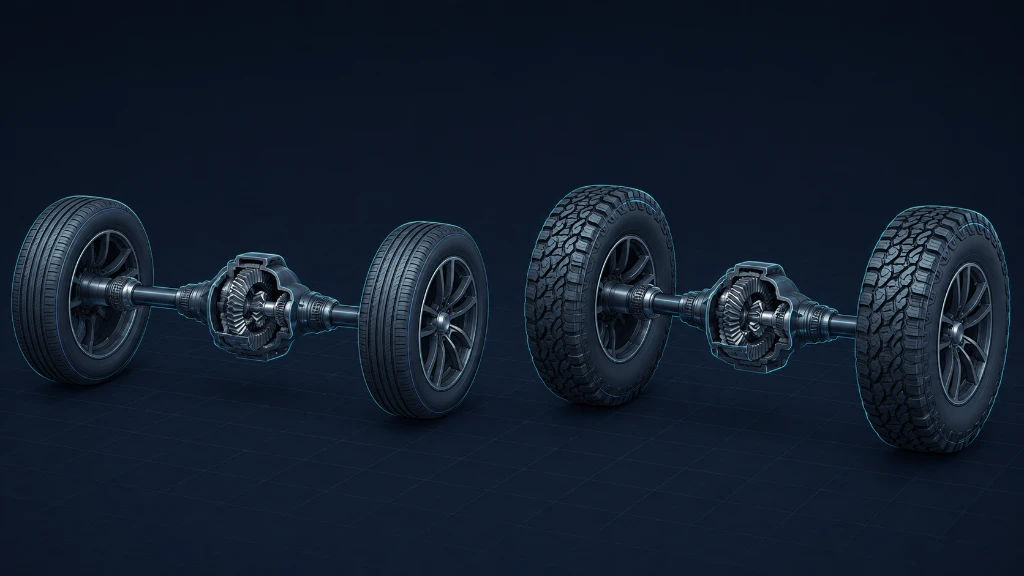
Mechanical Leverage Comparison: 31″ vs 35″ Tires on a 3.73:1 Differential Baseline
Understanding the Ratio to Restore Original Gearing
The mathematical restore ratio calculated by our tool tells you the exact theoretical ring-and-pinion gear ratio needed to bring driveshaft revolutions per mile back to factory baseline:
Effective Ratio = Current Axle Ratio × (Original Tire Diameter / New Tire Diameter)Restore Ratio = Current Axle Ratio × (New Tire Diameter / Original Tire Diameter)New RPM = Original RPM × (Original Tire Diameter / New Tire Diameter)When the calculated target falls between available gear sets, compare the ratios offered for your specific axle and evaluate the choice against the vehicle, transmission, engine, load, and intended use.
Does a Larger Tire Lower Engine RPM?
Yes, at the exact same vehicle road speed (such as 65 MPH) and in the same transmission gear, engine RPM drops proportionally with the increase in tire diameter.
Nominal Tire Dimensions vs. Real-World Rolling Diameter
Our tire size gear ratio calculator uses standard nominal tire geometry calculated from metric and flotation notations. In the real world, several factors introduce small physical variations:
- Tire Squat / Loaded Radius: Under vehicle curb weight, radial tires deflect at the contact patch, making the static loaded radius slightly less than theoretical half-diameter.
- Inflation Pressure & Rim Width: Mounting a tire on a wider wheel rim or running lower off-road pressures slightly reduces effective rolling height.
- Tread Wear: As tread wears, the tire's overall and rolling dimensions decrease. The amount depends on the tire's original tread depth and construction.
Do You Actually Need to Re-Gear?
There is no universal percentage threshold that dictates when a vehicle must be re-geared. The decision depends entirely on your mechanical platform and driving demands:
Factors That Can Make a Gearing Change More Noticeable
- Heavy tire weight / aggressive mud-terrain casings
- Frequent towing, payload, or overland armor
- Older 4-speed or 5-speed automatic transmissions
- Frequent mountain driving or sustained grades
- Frequent transmission gear hunting on highway grades
Factors That Can Make a Tire-Size Change Easier to Accommodate
- Modest 1-inch or 2-inch diameter upgrades
- Modern 8-speed or 10-speed transmissions with broad gear spreads
- Powertrains with sufficient torque across the operating range
- Flat-terrain highway commuting without towing
Frequently Asked Questions
References
Technical basis: Tire-size dimensions use standard tire geometry and Tire and Rim Association dimensional conventions. Effective gearing is calculated from the ratio between the original and replacement tire diameters while the physical axle ratio remains fixed.
- The Tire and Rim Association, Inc. (TRA): Tire and Rim Year Book Standards for Dimensional Geometry and Designations. https://www.us-tra.org/
- National Highway Traffic Safety Administration (NHTSA): Federal Motor Vehicle Safety Standards and Tire Identification Guidelines. https://www.nhtsa.gov/equipment/tires