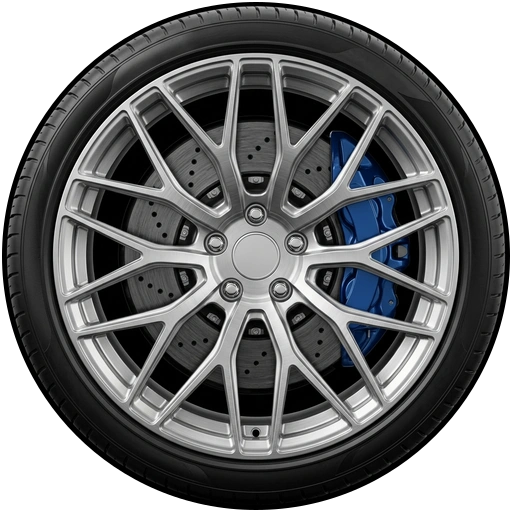
How to Read Tire Size: Tire Numbers & Dimensions Explained
Learn how to read tire size codes on your sidewall and calculate nominal physical dimensions. This guide breaks down section width, aspect ratio, wheel diameter, load index, and speed ratings with simple step-by-step calculations.
Decoding 225/45R17 94W
Key Takeaway: In the tire size 225/45R17, 225 is the section width in millimeters, 45 is the aspect ratio, R is radial construction, 17 is the wheel rim diameter in inches, and 94W represents the service description (load index and speed rating).
What Do the Numbers on a Tire Mean? How to Read Tire Size Codes
The alphanumeric code printed on a tire sidewall is standardized by international tire and rim organizations. Using our reference size 225/45R17 94W, each part of the code tells you something different about the tire: its size, construction, or load and speed capability:
225: Nominal Tire Section Width
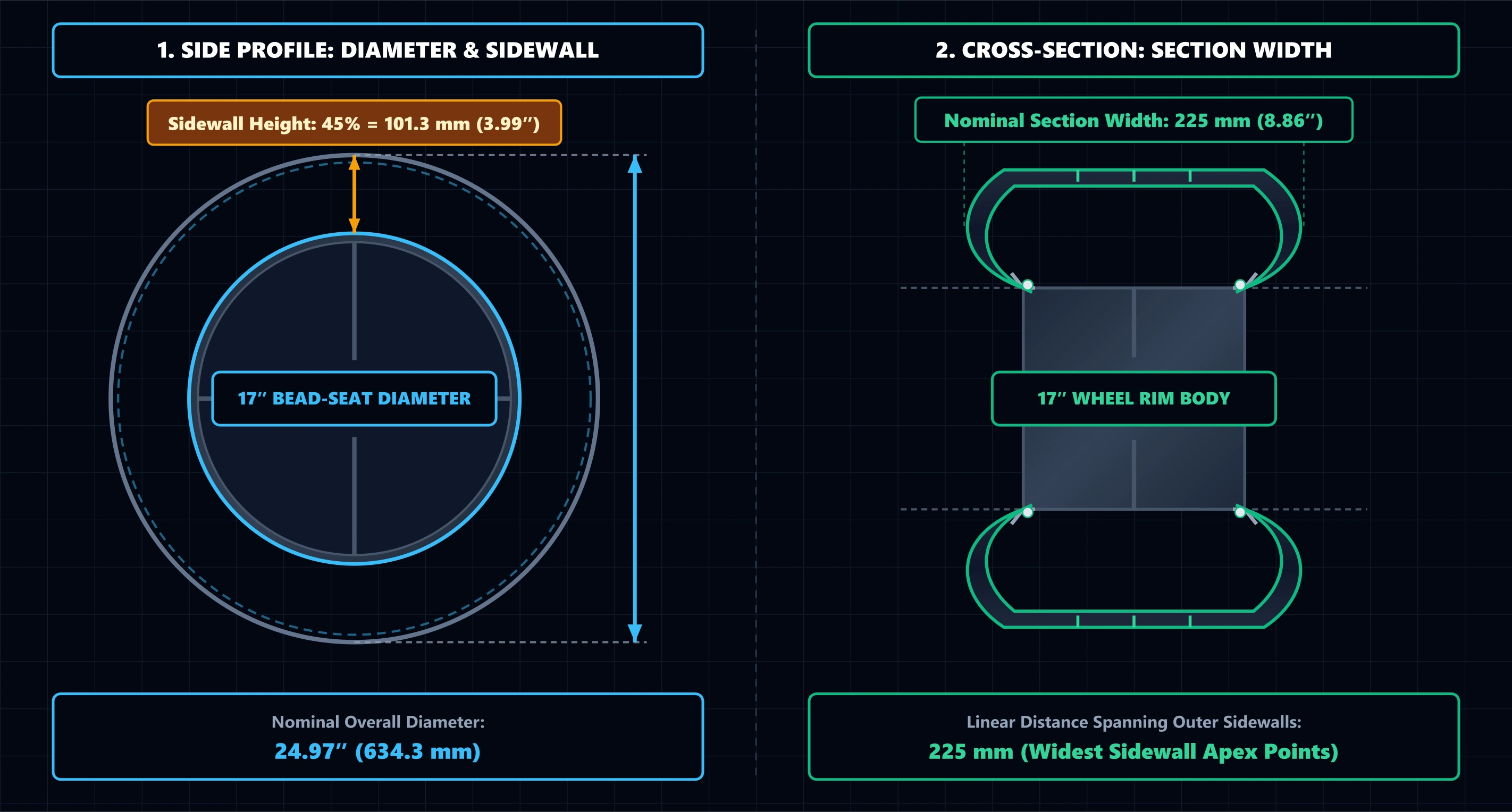
The first three-digit number indicates the tire's nominal section width in millimeters (225 mm, or approximately 8.86 inches). Section width measures the linear distance between the outer sidewalls at the widest point when properly inflated on a specified measuring rim. It is not the tread contact width, which is typically narrower than total section width.
45: Aspect Ratio (Sidewall Profile)
The two-digit number following the forward slash is the aspect ratio, also called the tire profile. It expresses the sidewall height as a percentage of nominal section width. In 225/45R17, the sidewall height is 45% of 225 mm, equal to 101.25 mm (3.99 inches). A lower aspect ratio indicates a shorter, stiffer sidewall for sharper steering response, while a higher ratio provides more cushion.
R: Internal Radial Construction
The letter R designates radial construction, the dominant construction used for modern passenger-car and light-truck tires. In a radial tire, the body cords run roughly 90° across the tire from bead to bead, with reinforcing belts beneath the tread. Alternative constructions include D for diagonal bias-ply and B for belted-bias designs.
17: Wheel Rim Diameter
The final two-digit number specifies the wheel rim diameter in inches (17 inches). This measurement refers strictly to the wheel's bead-seat diameter where the tire bead locks against the rim, not the outer decorative wheel lip or overall tire diameter. A 17-inch tire can only be safely mounted on a 17-inch diameter wheel.
94W: Service Description (Load Index & Speed Rating)
Positioned immediately after the rim diameter, the service description includes a numerical Load Index (94) and an alphabetical Speed Rating (W). The load index 94 corresponds to a maximum load capacity of 1,477 pounds (670 kg) per tire under the applicable standardized load-and-inflation conditions. The speed rating W indicates the tire is certified for speeds up to 168 mph (270 km/h).
Tire Sidewall Markings & Dimensional Geometry Breakdown
How Tire Dimensions Are Calculated from Size Codes
Tire markings provide the necessary variables to mathematically derive nominal overall tire diameter, circumference, and estimated revolutions per mile using standard conversion factors (1 inch = 25.4 mm, 1 mile = 63,360 inches):
Sidewall (mm) = Section Width (mm) × (Aspect Ratio / 100)
For 225/45R17: 225 × 0.45 = 101.25 mm (3.99 inches).
Diameter (in) = Rim Diameter (in) + [2 × Sidewall Height (mm) / 25.4]
For 225/45R17: 17.0 + [2 × 101.25 / 25.4] = 17.0 + 7.97 = 24.97 inches (634.3 mm).
Circumference (in) = Diameter (in) × π
For 225/45R17: 24.97 × 3.14159 = 78.45 inches (1,992.6 mm).
Revs/Mile = 63,360 inches / Circumference (in)
For 225/45R17: 63,360 / 78.45 ≈ 808 revs/mile.
| Dimension Property | Metric Value | Imperial (Inches) |
|---|---|---|
| Section Width | 225.0 mm | 8.86 in |
| Sidewall Height | 101.3 mm | 3.99 in |
| Rim Bead-Seat Diameter | 431.8 mm | 17.00 in |
| Overall Tire Diameter | 634.3 mm | 24.97 in |
| Outer Circumference | 1,992.6 mm | 78.45 in |
*Calculated values represent nominal theoretical dimensions. Actual mounted tire dimensions can vary depending on manufacturer casing design, measuring rim width, inflation pressure, vehicle load, and tread depth. If you want to look up nominal diameters for other sizes without calculating each one manually, browse our interactive tire diameter chart, which lists dimensions and revolutions per mile across all standard wheel sizes.
Calculate Your Tire Dimensions Instantly
Enter your tire size into our interactive tool to calculate nominal diameter, sidewall height, circumference, and estimated speedometer changes.
Why the Aspect Ratio Is Not the Sidewall Height
A common misconception is treating the aspect ratio number as an absolute millimeter height. Because aspect ratio is a relative percentage of section width, two tires with the exact same aspect ratio number will have different sidewall heights if their section widths differ:
205 mm × 0.55 = 112.75 mm (4.44″)
Total Diameter: 24.88 inches (631.9 mm).
245 mm × 0.55 = 134.75 mm (5.31″)
Total Diameter: 26.61 inches (675.9 mm).
Even though both tires are designated as 55-series tires on 16-inch rims, the wider 245 mm tire has a 22.0 mm (0.87 in) taller sidewall, increasing total outer diameter by 1.73 inches (44.0 mm).
Same Aspect Ratio (55), Different Sidewall Heights

Service Description: Load Index and Speed Rating
The service description follows the rim diameter and indicates the tire's load carrying capacity and maximum operating speed under standardized testing conditions established by organizations such as the Tire and Rim Association (TRA) and ETRTO:
Common Passenger Load Index Table
| Load Index | Max Load (lbs) | Max Load (kg) |
|---|---|---|
| 88 | 1,235 lbs | 560 kg |
| 91 | 1,356 lbs | 615 kg |
| 94 | 1,477 lbs | 670 kg |
| 98 | 1,653 lbs | 750 kg |
| 102 | 1,874 lbs | 850 kg |
| 106 | 2,094 lbs | 950 kg |
*Replacement tires should meet the vehicle manufacturer's specified size, load capacity/load index, and speed-rating requirements. View our complete Tire Load Index Chart for all standard ratings from 60 to 130.
Common Automotive Speed Ratings
| Rating | Maximum Speed |
|---|---|
| S | 112 mph (180 km/h) |
| T | 118 mph (190 km/h) |
| H | 130 mph (210 km/h) |
| V | 149 mph (240 km/h) |
| W | 168 mph (270 km/h) |
| Y | 186 mph (300 km/h) |
*Speed ratings reflect laboratory wheel testing capabilities and do not endorse exceeding legal highway speed limits.
Content is based on cited tire-industry standards, manufacturer documentation, and technical references where relevant.
P-Metric, Euro-Metric, and Light Truck (LT) Tire Sizing Systems
Tires in North America use prefixes and suffixes to specify the intended vehicle class and structural standard:
P-Metric (e.g. P225/45R17)
Designated by the P prefix, P-Metric tires are engineered according to U.S. TRA standards for passenger cars, minivans, and crossover SUVs.
Euro-Metric (e.g. 225/45R17)
Euro-Metric tires have no leading letter. Governed by ETRTO standards, they share nominal dimensions with P-metric tires but follow slightly different load calculation curves. When comparing P-Metric and Euro-Metric replacement tires, check the actual load capacity rather than assuming the same load-index number is always equivalent across standards.
LT-Metric (e.g. LT285/70R17)
LT-Metric tires are designed for light-truck service and higher load demands. Required inflation pressure depends on the tire size, load range, actual load, vehicle requirements, and the applicable load-and-inflation table.
How to Read Inch / Flotation Tire Sizes (e.g. 33×12.50R17LT)
Popular on trucks, SUVs, and off-road builds, high-flotation sizing expresses tire dimensions directly in decimal inches rather than metric millimeters:
- 33: Nominal overall outer diameter in inches (33.0″).
- 12.50: Nominal cross-section width in inches (12.50″).
- R: Radial casing construction.
- 17: Wheel rim diameter in inches (17″).
- LT: Light Truck heavy-duty designation.
Where to Find the Correct Tire Size for Your Vehicle
While reading the sidewall reveals the size currently mounted on your wheels, I recommend checking the vehicle placard before assuming those tires match factory specifications. On pre-owned or modified cars, previous owners or installers may have mounted non-standard sizes. To find your vehicle's factory-approved tire sizes and inflation pressures, check these primary locations:
1. Driver's Door-Jamb Placard (Authoritative)
Required under federal safety standard FMVSS No. 110, the Tire and Loading Information label identifies the vehicle's tire size designation and recommended cold inflation pressures, along with other required loading information. Depending on the vehicle and labeling format, additional service-description information may also appear.
2. Vehicle Owner's Manual
The technical specifications section of your vehicle handbook details standard and optional wheel/tire packages, spare tire specifications, and approved winter sizing. Drivers preparing for winter travel can also use your tire size to find matching tire chains from verified manufacturer listings.
What Happens When You Change Tire Sizes?
Altering tire diameter, section width, or wheel offset changes rotational speed and clearance geometry:
- Speedometer Accuracy: A taller tire travels farther per revolution, causing your speedometer to under-read actual road speed (you travel faster than indicated). A shorter tire causes the speedometer to over-read.
- Suspension & Fender Clearance: Wider tires or aggressive wheel offsets move the tire package closer to inner suspension struts or outward toward outer fender lips.
- Drivetrain Gearing & Engine RPM: A taller tire effectively raises overall gearing, which lowers engine RPM at highway cruising speeds but can slightly soften off-the-line acceleration.
- Approved Rim-Width Ranges: Every tire size must be installed within the manufacturer-approved rim-width range published in technical documentation like Michelin tire fitment specifications.
A difference of about ±3% in overall diameter is often used as an initial comparison guideline for passenger vehicles, but it is not an approval rule. Always verify the vehicle manufacturer's requirements, tire load capacity, approved rim width, mechanical clearance, and inflation requirements before changing tire sizes with our Tire Fitment Calculator and Wheel Offset Calculator.
Frequently Asked Questions About Reading Tire Sizes
Common questions about decoding sidewall codes, aspect ratios, and dimensional calculations:
References
- National Highway Traffic Safety Administration (NHTSA) — Federal Motor Vehicle Safety Standards (FMVSS No. 110 & 139)
- The Tire and Rim Association (TRA) — 2026 Year Book of Standards
- U.S. Tire Manufacturers Association (USTMA) — Replacement Tire Fitment & Service Standards
- Michelin North America — Tire Sizing, Speed Rating & Load Index Guide