Tire Size Calculator
Use this tire size calculator to compare two tire sizes and see the difference in diameter, sidewall height, circumference, revolutions per mile, and theoretical road speed. Enter your stock tire size and a replacement size to compare the dimensions side by side.
Compare Tire Sizes
Stock vs ReplacementVisual Tire Comparison
Compare stock and replacement tire dimensions to scale.
Detailed Geometry ComparisonStock vs Replacement
| Metric Parameter | Stock (225/45R17) | Replacement (245/45R17) | Difference |
|---|---|---|---|
| Section Width | 225 mm (8.86″) | 245 mm (9.65″) | +20 mm |
| Sidewall Height | 101.3 mm (3.99″) | 110.3 mm (4.34″) | +9.0 mm |
| Overall Diameter | 24.97″ (634.3 mm) | 25.68″ (652.3 mm) | +0.71″ |
| Circumference | 78.45″ (1993 mm) | 80.68″ (2049 mm) | +2.23″ |
| Revolutions per Mile | 808 revs/mi | 785 revs/mi | -23 revs/mi |
| Revolutions per Km | 502 revs/km | 488 revs/km | -14 revs/km |
Speedometer Calibration Variance
Calculate actual driving speed at custom indicated speeds.
Calculations use documented geometric and mathematical relationships, with tire-industry standards and manufacturer specifications referenced where relevant.
How to Use the Tire Size Calculator
Enter stock and replacement tire sizes to compare overall diameter, geometric radius change, revolutions per mile, and estimated speedometer differences.
- Enter your original factory tire specification into the Stock Tire field using direct text entry (e.g.,
225/45R17or flotation size33x12.50R15) or dropdown selectors. - Enter your replacement size into the Replacement Tire field.
- Review the Diameter Difference %, Diameter Change, and Radius / Clearance Change result cards.
- Use the interactive Visual Tire Comparison to inspect tire cross-section profiles side by side or overlaid.
Tire Size Comparison: Stock vs. Replacement Dimensions
When comparing two tire sizes, each dimensional parameter changes how the wheel assembly fits within the wheel well and behaves on the road:
Overall Diameter & Clearance
Overall diameter determines total tire height from tread to tread. Changes in diameter alter axle height, suspension strut clearance, and wheel-well arch spacing.
Section Width & Lateral Room
Section width is the widest cross-sectional measurement of the unburdened tire sidewalls. A wider nominal section width requires more lateral clearance and may change the shape of the tire’s contact patch, while reducing clearance to inner suspension components and outer fender lips.
Sidewall Height & Ride Compliance
A shorter sidewall reduces the nominal distance between the rim and tread. Actual ride, steering response, and impact behavior also depend on tire construction, inflation pressure, wheel width, and vehicle suspension.
Nominal Circumference & Gearing
A larger nominal circumference represents more geometric distance per tire revolution. In real use, manufacturer-published rolling circumference or revolutions-per-mile data may differ from the geometric calculation.
How to Read Your Tire Comparison Results
Evaluating tire comparison outputs requires understanding both the mathematical meaning of each value and its practical fitment implications:
| Result Output | What It Means & Practical Guidance |
|---|---|
| Diameter Difference % | A ±3% diameter difference is commonly used as a quick comparison reference, but it is not a universal fitment, drivetrain, or safety limit. |
| Diameter Change | Represents the total absolute change in outer tire diameter. Positive values indicate a taller tire; negative values indicate a shorter tire. |
| Radius / Clearance Change | Tire radius equals half the overall tire diameter. This output shows the geometric radius change — half of the overall diameter change. It may approximate the vertical clearance change at components that directly follow tire radius, but actual vehicle clearance changes also depend on suspension geometry, wheel offset, wheel width, tire construction, and steering movement. |
| Section Width Difference | Indicates the nominal section width change. Actual installed fitment also depends on wheel width, wheel offset (ET), tire construction, suspension geometry, and fender clearance. |
| Revolutions per Mile | Helps estimate changes in distance per revolution, odometer behavior, and effective drivetrain gearing. These are nominal geometric estimates; real manufacturer-published rolling revolutions per mile may differ. For a dedicated revolutions per mile tool, see the Tire Revolutions Per Mile Calculator. |
| Speedometer Variance | Estimates the theoretical road-speed difference associated with the change in nominal tire circumference. Actual indicated-speed behavior depends on the vehicle’s calibration and speed-sensing system. |
How Overall Tire Size Geometry Is Calculated
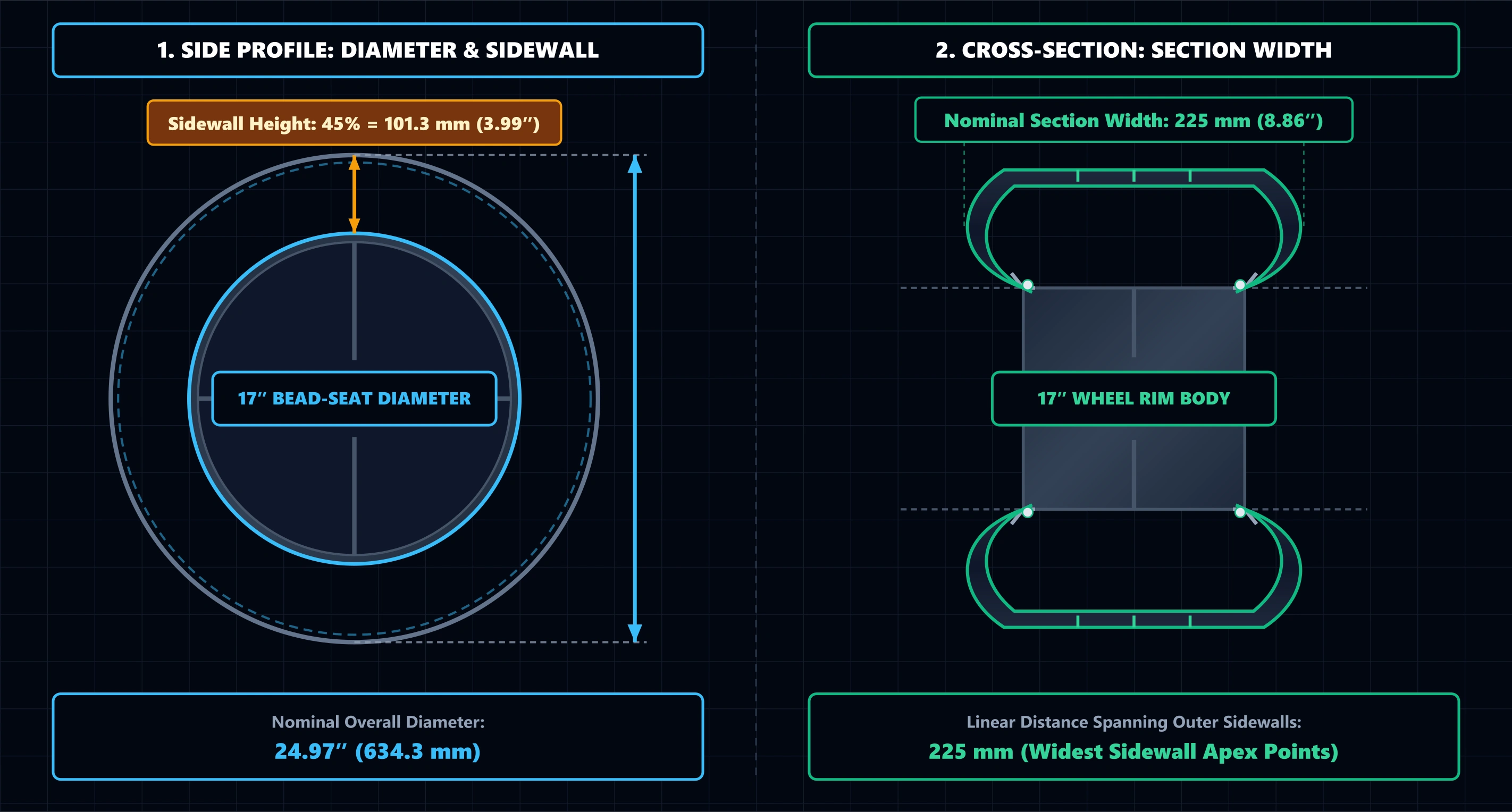
Tire height is an informal term for overall tire outer diameter — the full outer measurement across the tire from tread surface to opposite tread surface through the center axis. Tire radius is exactly half the overall diameter. Sidewall height (the structural portion between the bead seat and tread) is calculated from the section width and aspect ratio; aspect ratio is also informally called the tire profile or sidewall profile number.
Tire specifications convey section width in millimeters, sidewall height as a percentage ratio, and wheel rim diameter in inches. This calculation engine uses standard dimensional conversion equations (1 inch = 25.4 mm, 1 mile = 63,360 inches):
Sidewall Height (mm) = Section Width (mm) × (Aspect Ratio / 100)Overall Diameter (in) = Rim Diameter (in) + 2 × [Sidewall Height (mm) / 25.4]Tire Radius (in) = Overall Diameter (in) / 2Circumference (in) = Overall Diameter (in) × πRevs/Mile = 63,360 inches / Circumference (in)Diameter Difference % = [(New Diameter - Stock Diameter) / Stock Diameter] × 100Radius Change (in) = (New Diameter - Stock Diameter) / 2Understanding Tire Size Markings: 225/45R17
A tire size such as 225/45R17 encodes nominal dimensional and construction information. U.S. regulations also require specified safety and identification information to appear on tire sidewalls:
- 225 (Nominal Section Width): The nominal tire section width in millimeters. Actual mounted section width can vary slightly by tire model, measuring rim width, and manufacturer specifications.
- 45 (Aspect Ratio): Sidewall height expressed as a percentage of nominal section width (225 × 0.45 = 101.25 mm). The aspect ratio is also informally called the tire profile or sidewall profile number — a lower number means a shorter, lower-profile sidewall.
- R (Internal Construction): Radial construction.
- 17 (Wheel / Rim Diameter): The nominal wheel diameter in inches measured at the tire bead-seat diameter, not the visible outer wheel lip.
For a complete explanation of tire markings, load index, speed rating, and sidewall codes, see How to Read Tire Size. To convert a single tire specification between metric notation and inch flotation format, use the Tire Size Conversion Calculator. For two-wheel metric applications and axle-height deltas, use our dedicated Motorcycle Tire Size Calculator. For winter driving equipment, you can also find manufacturer-listed tire chains for your tire size.
Tire Sidewall Markings & Dimensional Geometry Breakdown
Tire Size, Diameter Difference, and Wheel-Well Clearance
When changing tire sizes, overall diameter directly dictates vertical axle displacement and radial clearance inside the wheel arch. Tire radius equals exactly half the overall diameter:
The ±3% Diameter Guideline: In automotive aftermarket fitment, keeping overall diameter within ±3% of the factory stock tire is widely used as a comparative screening rule of thumb. However, this is an empirical reference guideline, not an absolute engineering safety limit.
A tire that falls within ±3% may still rub suspension struts, control arms, or fender liners if rim offset or section width is unsuitable. Conversely, vehicles with generous wheel well packaging or lifted suspensions can accommodate larger diameter variations. For detailed fitment clearances, see the Tire Fitment Calculator and Wheel Offset Calculator.
Theoretical Road-Speed Difference & Speedometer Calibration
Vehicle speedometers do not measure linear velocity over the ground; they measure rotational speed at the transmission output shaft, wheel hubs, or ABS tone rings. Because indicated speed assumes the factory tire circumference:
Taller Replacement Tire
If the vehicle’s indicated speed is calibrated to the stock tire’s rolling relationship, a larger replacement circumference produces a higher theoretical road speed at the same rotational speed.
Shorter Replacement Tire
If the vehicle’s indicated speed is calibrated to the stock tire’s rolling relationship, a smaller replacement circumference produces a lower theoretical road speed at the same rotational speed.
AWD & 4WD Tire Matching: Some AWD and 4WD driveline systems are sensitive to differences in actual rolling circumference between tires. Follow the vehicle manufacturer’s requirements for tire size, tread-depth matching, and allowable circumference differences.
Revolutions per Mile & Drivetrain Gearing Effects
Tire revolutions per mile directly dictate how many rotations the wheel hub completes over a measured statute mile. Changing revs per mile alters the effective overall gearing relationship of your vehicle:
- Fewer Revs/Mile (Taller Tire): Produces a taller effective overall gearing relationship. For a given road speed, wheel and drivetrain rotational speed would be lower if all other gearing remains unchanged.
- More Revs/Mile (Shorter Tire): Produces a shorter effective overall gearing relationship. For a given road speed, wheel and drivetrain rotational speed would be higher if all other gearing remains unchanged.
To evaluate axle ratio adjustments when changing tire size, use the Tire Size Gear Ratio Calculator.
Equivalent Tire Sizes, Plus Sizing & Alternatives
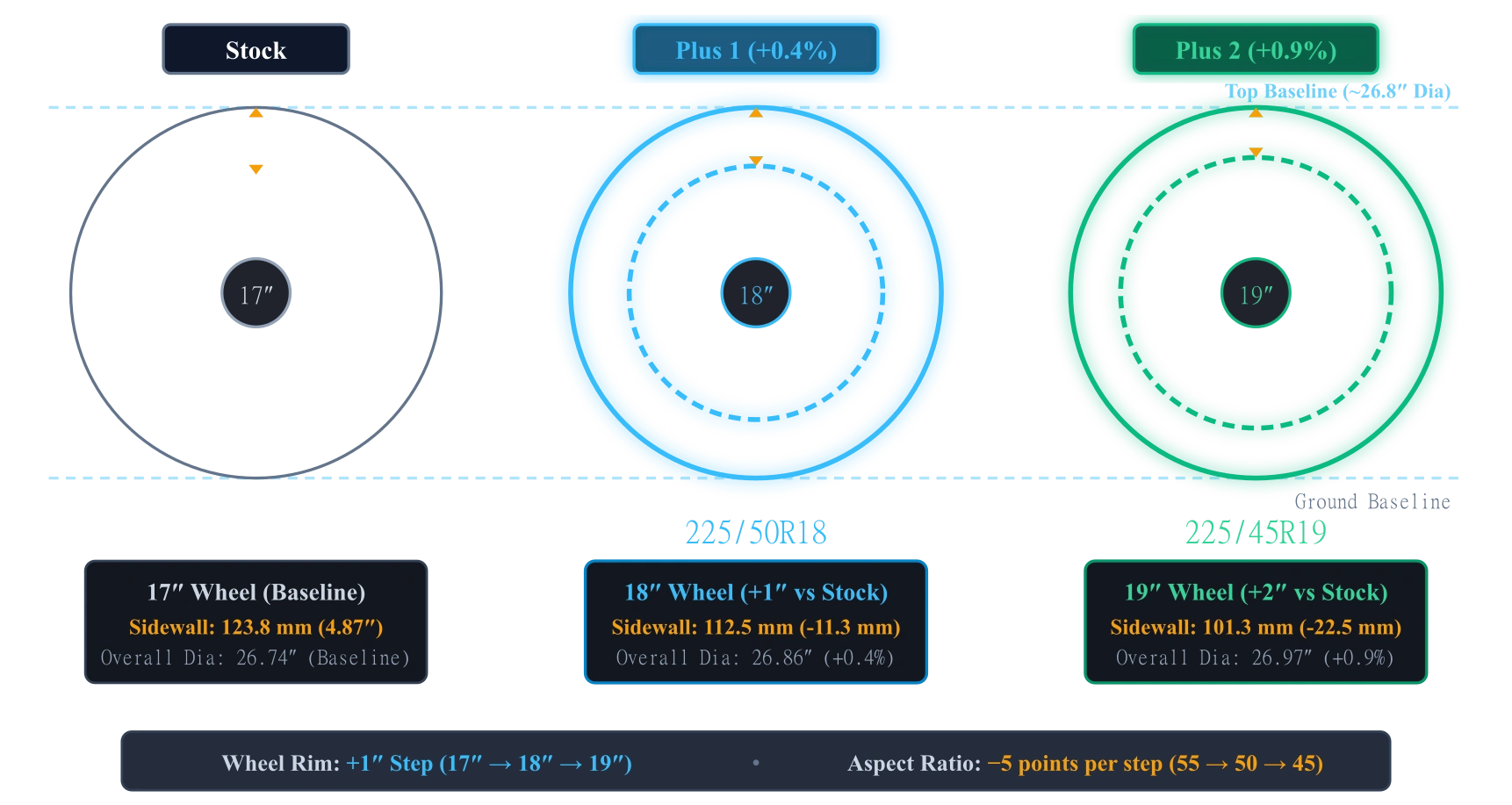
Plus sizing pairs a larger-diameter wheel with a lower-profile tire so overall tire diameter remains reasonably close to the original size. When selecting replacement tires, follow the vehicle and tire manufacturers' recommendations. The U.S. Tire Manufacturers Association (USTMA) also publishes tire replacement and fitment guidance for passenger and light-truck tires. You can also explore equivalent standard outer dimensions on our Tire Diameter Chart.
Overall diameter is only one component of vehicle fitment. Fitment also depends on:
- Section Width & Rim Width: Ensuring the tire section width is mounted within the manufacturer-approved rim-width range.
- Wheel Offset (ET) & Backspacing: Ensuring replacement wheels maintain adequate inner suspension clearance and outer fender clearance.
- Load Index: Verify that the replacement tire meets the vehicle's required load capacity.
- Speed Rating: Verify the appropriate speed rating for the vehicle and intended application.
Plus-Sizing Progression: Stock (17″) vs Plus 1 (18″) vs Plus 2 (19″)
Calculation Methodology & Real-World Limitations
TireCalculator.net calculates nominal tire geometry from the dimensions encoded in the tire size designation using standard unit conversions. In the North American market, The Tire and Rim Association (TRA) publishes standardized tire designations, dimensions, load ratings, and approved rim information.
Actual mounted dimensions and real rolling behavior may vary because of tire model, measuring rim width, inflation pressure, vehicle load, casing construction, tread depth, deformation under load, and manufacturing tolerances.
Nominal section width, loaded radius, rolling circumference, and revolutions per mile can differ from geometric calculations. For close-fitment, drivetrain-sensitive, or purchasing decisions, verify the tire manufacturer's published specifications, approved rim-width range, and the vehicle manufacturer's requirements.
Worked Example: 225/45R17 vs 245/45R17
The following tire size comparison table shows the calculator results for a factory 225/45R17 tire compared against a wider 245/45R17 replacement size:
| Measurement Parameter | Stock (225/45R17) | Replacement (245/45R17) | Calculated Difference |
|---|---|---|---|
| Section Width | 225 mm (8.86″) | 245 mm (9.65″) | +20 mm (+0.79″) |
| Sidewall Height | 101.3 mm (3.99″) | 110.3 mm (4.34″) | +9.0 mm (+0.35″) |
| Overall Diameter | 24.97″ (634.3 mm) | 25.68″ (652.3 mm) | +0.71″ (+18.0 mm) |
| Diameter Difference % | Baseline (0.0%) | +2.8% Variance | +2.8% |
| Radius / Clearance Change | Baseline (0.00″) | +0.35″ (+9.0 mm) | +0.35″ (+9.0 mm) |
| Circumference | 78.45″ (1993 mm) | 80.68″ (2049 mm) | +2.23″ (+56 mm) |
| Estimated Geometric Revs/Mile | 808 revs/mi | 785 revs/mi | -23 revs/mi |
Speedometer Calibration Effect: At an indicated dashboard speed of 60 mph, actual speed is approximately 61.7 mph (actual speed is approximately 2.8% higher than the indicated speed). This occurs because the taller 25.68″ replacement tire has a nominal geometric circumference of 80.68 inches, traveling 2.23 inches farther per wheel revolution than the 24.97″ stock tire.
Frequently Asked Questions
Authoritative Sources
- National Highway Traffic Safety Administration (NHTSA): Tire Safety, Ratings, and Regulatory Sidewall Labeling Overview. https://www.nhtsa.gov/equipment/tires
- U.S. Tire Manufacturers Association (USTMA): Replacement Guidance for Passenger and Light Truck Tires. https://www.ustires.org/replacement-tires
- The Tire and Rim Association, Inc. (TRA): Standards Organization for Tire, Rim, and Interchangeability Information. https://www.us-tra.org/